Return and Refund Devices in 2025: What You Need to Know
Return and Refund Devices in 2025: What You Need to Know
Jun 13, 2025
Discover how reverse vending machines help DRS programs, reduce waste, and boost recycling with instant refunds and sustainable benefits.
Discover how reverse vending machines help DRS programs, reduce waste, and boost recycling with instant refunds and sustainable benefits.
In a world marked by unprecedented waste generation and its cascading environmental impact, technology-led innovation arises as the beacon of hope, showing us the path towards a more resource-efficient and sustainable future.
As the world grapples with the pressing need to address issues like waste pollution, climate change and resource depletion, the drive to innovate solutions to combat them has never been more important.
Amidst this backdrop of innovation for sustainability, return and refund devices (RRDs) emerge as the union of technology and environmentalism, providing a solution to one of the most pressing challenges we face right now: waste pollution.
In this blog, we will discuss reverse vending machines, their benefits for Deposit Refund System (DRS) and Bottle Bill programs, and how they actually work.
Understanding Return and Refund Devices
Return and refund devices are machines that accept bottles, cans, and other recyclable materials from consumers and offer them a reward for submitting them as part of deposit refund systems (DRS) or Bottle Bill programs.
They provide a convenient and accessible alternative to manual collection points, thus reducing littering of recyclable materials and increasing recycling rates.
While there are different types of reverse vending machines available in the market today, most of them perform similar functions: they identify and sort the containers while providing refunds to consumers.
History of Reverse Vending Machines
Elmer M. Jones and Sue Walker Vance filed the first patent for an RVM on September 13, 1920, for an "Empty Container Return and Handling Machine" with a coin return mechanism.
However, it wouldn’t be until the 1950s that the first working version of the machine was invented, produced, and used by Wicanders in Sweden. While this machine was functional, it was very simplistic, accepting only plastic bottles one after another.
In 1962, Norway-based Aage Tveitan and his firm Arthur Tveitan ASA further improved on this, manufacturing the "Advanced Bottle Return Machine." This device was capable of accepting different types of plastic bottles simultaneously, laying the foundation for the present-day RVMs.
Benefits of Return and Refund Devices
There are several benefits to using reverse vending machines as part of the DRS programs. Here are some of them:
These machines are placed in public places like malls, parks and supermarkets, making them easily accessible to consumers.
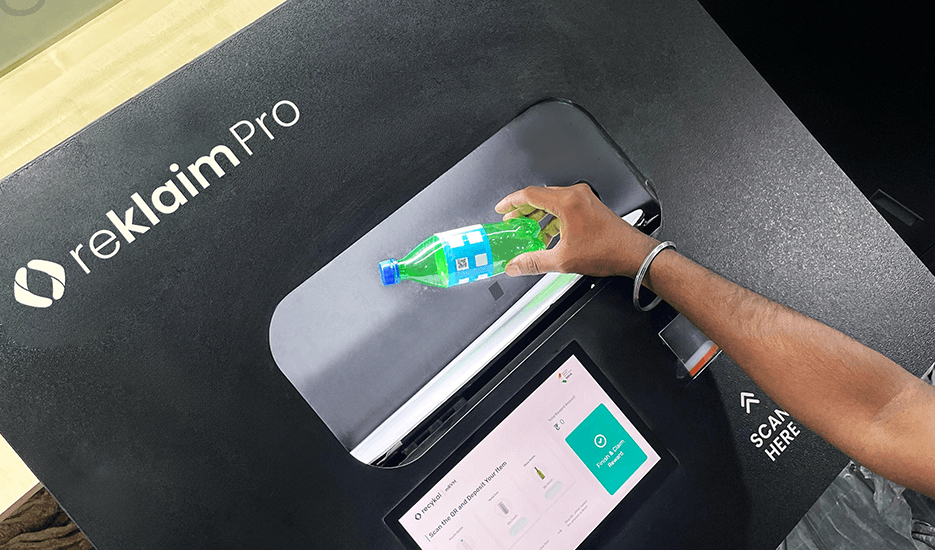
Many return and refund devices, like Recykal's reklaim Pro, automatically sort the containers after submission, reducing the need for manual labour to do so.
RRDs are equipped with the technology to accurately count and identify containers, reducing the risks of errors and fraud.
The joy of getting instant refunds from RRDs can encourage more consumers to participate actively in the Deposit Refund System.
How do Return and Refund Devices Work?
Reverse vending machines accept different types of containers like plastic & glass bottles, aluminium cans, multi-layered plastic packaging and tetra paks as per the scope of the DRS program implemented in that region. Here's how the RRDs work:
Consumers present the container for the RRD to scan the affixed code and validate the material, ensuring it is a part of the DRS program.
After verification, the machine accepts the container and separates it by material type, preventing cross-contamination of the collected materials.
The consumer receives the promised incentive for returning the container. This can be in the form of monetary refunds or coupons to be used in the participating retail store.
The collected materials are stored within the RRD until the bin reaches its total capacity or till the scheduled pickup.
Final Notes
Since the first patent for the device in the 1920s, the technology powering reverse vending machines has come a long way. RRDs have evolved from automated machines collecting just one container and handing out refund slips to AI-driven high-end devices, like Recykal's reklaim Pro, that accept multiple containers and provide digital refunds directly into the consumer's bank account.
reklaim Pro is an Artificial Intelligence-powered IoT device that ensures a faster and smoother return and refund experience for consumers. It identifies the containers in less than 40 milliseconds and accepts and segregates them at a speed of two containers per second.
The device is equipped with anti-spoofing drop detection sensors to prevent counting errors and frauds and refunds directly to the consumer's bank account through UPI-based digital transactions.
Are you interested in learning more about Reklaim Pro and how it can enhance your DRS program? Contact us today.
In a world marked by unprecedented waste generation and its cascading environmental impact, technology-led innovation arises as the beacon of hope, showing us the path towards a more resource-efficient and sustainable future.
As the world grapples with the pressing need to address issues like waste pollution, climate change and resource depletion, the drive to innovate solutions to combat them has never been more important.
Amidst this backdrop of innovation for sustainability, return and refund devices (RRDs) emerge as the union of technology and environmentalism, providing a solution to one of the most pressing challenges we face right now: waste pollution.
In this blog, we will discuss reverse vending machines, their benefits for Deposit Refund System (DRS) and Bottle Bill programs, and how they actually work.
Understanding Return and Refund Devices
Return and refund devices are machines that accept bottles, cans, and other recyclable materials from consumers and offer them a reward for submitting them as part of deposit refund systems (DRS) or Bottle Bill programs.
They provide a convenient and accessible alternative to manual collection points, thus reducing littering of recyclable materials and increasing recycling rates.
While there are different types of reverse vending machines available in the market today, most of them perform similar functions: they identify and sort the containers while providing refunds to consumers.
History of Reverse Vending Machines
Elmer M. Jones and Sue Walker Vance filed the first patent for an RVM on September 13, 1920, for an "Empty Container Return and Handling Machine" with a coin return mechanism.
However, it wouldn’t be until the 1950s that the first working version of the machine was invented, produced, and used by Wicanders in Sweden. While this machine was functional, it was very simplistic, accepting only plastic bottles one after another.
In 1962, Norway-based Aage Tveitan and his firm Arthur Tveitan ASA further improved on this, manufacturing the "Advanced Bottle Return Machine." This device was capable of accepting different types of plastic bottles simultaneously, laying the foundation for the present-day RVMs.
Benefits of Return and Refund Devices
There are several benefits to using reverse vending machines as part of the DRS programs. Here are some of them:
These machines are placed in public places like malls, parks and supermarkets, making them easily accessible to consumers.
Many return and refund devices, like Recykal's reklaim Pro, automatically sort the containers after submission, reducing the need for manual labour to do so.
RRDs are equipped with the technology to accurately count and identify containers, reducing the risks of errors and fraud.
The joy of getting instant refunds from RRDs can encourage more consumers to participate actively in the Deposit Refund System.
How do Return and Refund Devices Work?
Reverse vending machines accept different types of containers like plastic & glass bottles, aluminium cans, multi-layered plastic packaging and tetra paks as per the scope of the DRS program implemented in that region. Here's how the RRDs work:
Consumers present the container for the RRD to scan the affixed code and validate the material, ensuring it is a part of the DRS program.
After verification, the machine accepts the container and separates it by material type, preventing cross-contamination of the collected materials.
The consumer receives the promised incentive for returning the container. This can be in the form of monetary refunds or coupons to be used in the participating retail store.
The collected materials are stored within the RRD until the bin reaches its total capacity or till the scheduled pickup.
Final Notes
Since the first patent for the device in the 1920s, the technology powering reverse vending machines has come a long way. RRDs have evolved from automated machines collecting just one container and handing out refund slips to AI-driven high-end devices, like Recykal's reklaim Pro, that accept multiple containers and provide digital refunds directly into the consumer's bank account.
reklaim Pro is an Artificial Intelligence-powered IoT device that ensures a faster and smoother return and refund experience for consumers. It identifies the containers in less than 40 milliseconds and accepts and segregates them at a speed of two containers per second.
The device is equipped with anti-spoofing drop detection sensors to prevent counting errors and frauds and refunds directly to the consumer's bank account through UPI-based digital transactions.
Are you interested in learning more about Reklaim Pro and how it can enhance your DRS program? Contact us today.
Related Blogs
Read More From Our Blog
Read More From Our Blog
Join our newsletter list
Sign up to get the most recent blog articles in your email every week.